The short answer: HIFU can feel uncomfortable but should not be unbearable. Most clients rate it around 3 to 6 out of 10 depending on the treatment area. It is an honest, noticeable sensation, but with the right practitioner and device, it is very manageable. If you want to understand the full treatment process, our HIFU treatment in London page covers everything in detail.
If you have been putting off HIFU because you are worried about pain, this guide will give you a realistic picture of what to expect. Not the sugar-coated version. The honest one.
What this guide covers:
How HIFU actually feels during treatment
Pain levels by face area (with table)
Why some people say HIFU is painful
How your practitioner controls comfort
What to expect after treatment
On this page
What Does HIFU Feel Like?
HIFU delivers focused ultrasound energy deep into the skin. During each pulse, you feel a sensation that most clients describe as a combination of:
Deep warmth
A concentrated heat that builds and fades with each pulse. Not a burning sensation, but a firm, focused warmth.
Small zapping
Brief, sharp points of energy. Some describe it as tiny electrical pulses. Each one lasts less than a second.
Muscle twitching
When the SMAS layer is targeted (4.5mm depth), you may feel involuntary muscle flickering. This is normal and means the treatment is reaching the correct depth.
The sensation only lasts while each pulse is being delivered. Between pulses, there is no pain. It is not a continuous feeling. It comes and goes. If you want to understand how HIFU works at a deeper level, our guide on how HIFU really works covers the full mechanism.
HIFU Pain Levels by Area
Not all areas feel the same. Pain level depends on skin thickness, proximity to bone, and the treatment depth used. Here is a realistic breakdown:
Key point: Deeper treatment generally means more sensation, but also stronger results. The areas where you feel more are often the areas that benefit most.
Here is a visual breakdown of HIFU treatment areas, pain levels, and results:
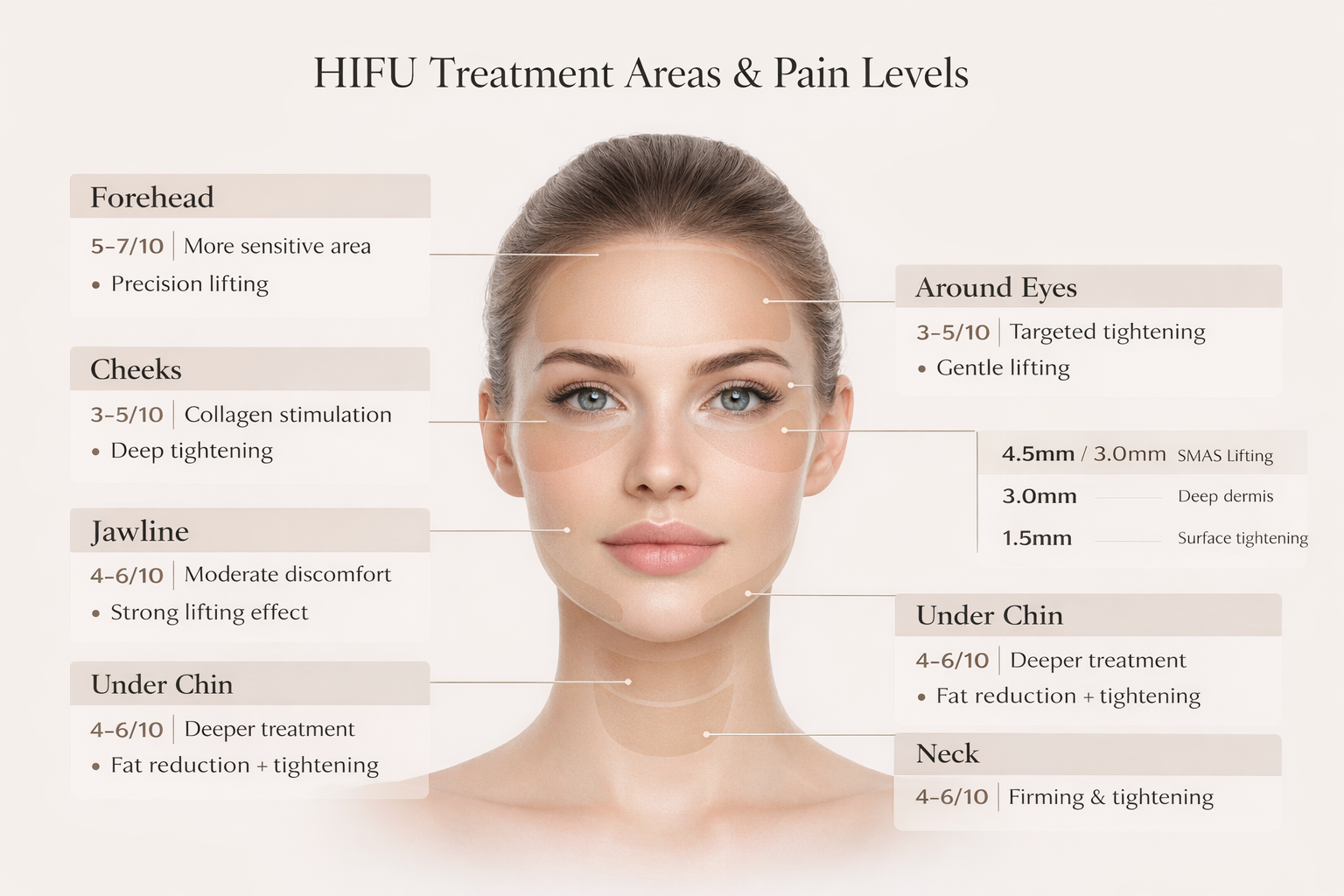
HIFU treatment areas mapped with typical discomfort levels and treatment depth.
Still unsure? Read how results develop over time Does HIFU Really Work
Which Areas Hurt the Most?
The forehead is consistently the most sensitive area. The skin is thinner, closer to bone, and there is less soft tissue to absorb the energy. Most clients notice the forehead more than any other area.
The jawline and under chin can also feel more intense because treatment here targets the deeper SMAS layer at 4.5mm. This is where the strongest lifting effect comes from. The sensation is more of a deep pressure than a sharp pain.
The cheeks and around the eyes tend to be the most comfortable areas. Thicker skin, softer tissue, and lower energy settings make these areas very manageable for most clients.
I always adjust energy and pacing based on each area and each client. If the forehead feels too intense, I lower the energy slightly. The result still builds over time. Comfort should never be sacrificed.
Why Do Some People Say HIFU Is Painful?
If you have read horror stories about HIFU pain, there is usually a reason. It is rarely the treatment itself. It is how the treatment was performed. For context on broader safety questions, see our guide on whether HIFU is safe.
Incorrect depth settings
Using 4.5mm on thin or bony areas where 1.5mm or 3.0mm would be more appropriate causes unnecessary pain. Depth must be matched to the tissue, not used at maximum across the whole face.
Poor technique and pacing
Rushing through treatment without allowing the client to recover between pulses creates a cumulative discomfort that feels overwhelming. Slow, considered treatment is always more comfortable.
Cheap or outdated devices
Lower-quality devices deliver energy less precisely, causing broader heat dispersion. This leads to more discomfort and less targeted results. Device quality matters significantly.
Excessive energy levels
Some practitioners use maximum energy on every area to "get a stronger result". This is not how HIFU works best. Controlled, layered energy produces better collagen response with less discomfort.
Can HIFU Be Made More Comfortable?
Yes. The difference between an uncomfortable HIFU session and a manageable one almost always comes down to the practitioner.
Most discomfort comes down to technique. With the correct depth, pacing, and device, HIFU should feel controlled, not overwhelming.
Not sure how your skin will respond?
Send me a photo on WhatsApp and I will tell you honestly what to expect before you book.
Not sure which treatment is right for you?
Send me a photo on WhatsApp and I will tell you honestly what to expect before you book.
Usually responds within a few hours
Does HIFU Hurt After Treatment?
After your HIFU session, the treatment sensation stops immediately. There is no lingering pain. However, you may notice some mild after-effects over the following days:
Tenderness
Mild tenderness when touching treated areas. Usually 24 to 72 hours. Similar to the feeling after a deep tissue massage.
Slight soreness
Some clients describe a dull ache in the jawline or under chin for a day or two. This fades naturally.
Tight feeling
A subtle tightness in the skin is common and actually a positive sign. It means the collagen process has begun.
No visible downtime. Most clients return to normal activities immediately after treatment. You can wear makeup, go to work, and continue your day. For questions about HIFU and fat loss effects, see our guide on whether HIFU melts fat.
Who Might Find HIFU More Uncomfortable?
Everyone experiences sensation differently. Based on treating hundreds of clients, these factors tend to increase sensitivity:
What Most Clients Actually Say
Almost every client tells me the same thing: "It was not as bad as I expected."
The anticipation is usually worse than the reality. Once the treatment starts and you understand the rhythm of the pulses, most people settle into it comfortably. Some even close their eyes and relax between areas.
I have never had a client ask me to stop mid-treatment because of pain. That should tell you something.